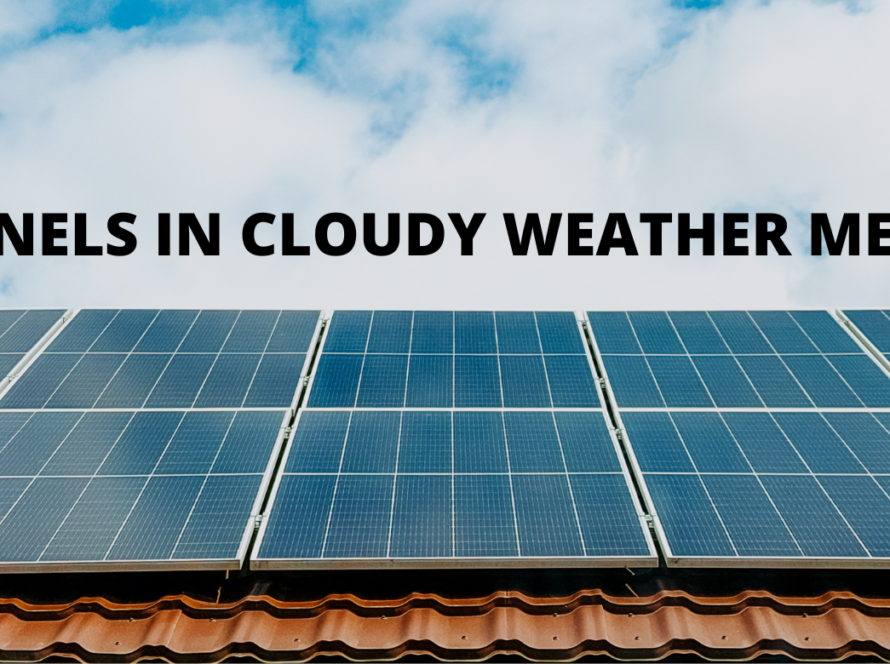

No, direct sunshine is not necessary for solar panels to produce power. Modern photovoltaic panels use the photons found in natural daylight, not the heat from the sun, to generate electricity, but they operate at their best under direct, bright sunlight. This means that on foggy, hazy, or gloomy days, your system will still produce energy from diffuse and spread out sunshine. Households across Australia may still offset a significant percentage of their daily power use under less-than-ideal weather conditions, even though energy production may decrease depending on cloud density.
How Do Solar Panels Work Without Direct Sunlight?
One of the most common questions our experts at The Solar King get asked for many years is whether adding a solar system is worth the investment if the property gets a lot of cloud cover. For it understand why the answer is absolutely “yes,” it is helpful to examine the fundamental physics of solar energy production.
Photovoltaic (PV) cells, which are usually formed of silicon, make up solar panels. An electrical current is produced when natural sunshine hits these cells, causing a reaction that releases electrons. Here, light (photons) is more important than heat or the sun’s direct, visible rays. Your solar panels are always “awake” and producing electricity from dawn till sunset because photons remain as long as there is visible sunshine.
What Australian Homeowners Should Know About Direct vs. Diffuse Sunlight
The solar business splits daylight into two categories when calculating your solar potential:
- Direct sunshine: The unobstructed rays of sunshine that reach your roof on a clear day. This results in the greatest energy yield and maximal photon concentration.
- Diffuse Sunlight: Sunlight that has been scattered by clouds, fog, rain, or atmospheric particles. While less concentrated, these scattered photons still reach your roof, penetrating the PV cells and continuing to produce reliable electricity.
How Cloud Cover Affects Solar Panel Efficiency
While the answer to the question “do solar panels need direct sunlight” is no, we believe in complete transparency: your system’s efficiency will vary depending on the density of the cloud cover.
Here is what you can normally anticipate from your solar panel efficiency on foggy days in Australia:
- High-Level or Thin Cloud Coverage: Output is mostly unaffected, often reducing to just 70% to 90% of your system’s full capability.
- Standard Overcast Conditions: When the sky is entirely grey but quite bright, solar output typically ranges between 25% and 60%. For a well-sized system, this is often sufficient to power your basic home appliances.
- Low-Level, Dark Storm Clouds: During heavy rain or strong thunderstorms, sunlight is significantly obstructed. Output may fall by 10% to 25% of typical capacity.
The Heat Myth: Why Scorching Days Aren't Always Better
A common myth among Australians is that a scorching 40°C summer day results in the highest solar production. In actuality, solar panels may lose efficiency when they get too hot.
This phenomena is determined using a panel’s temperature coefficient. Once the ambient temperature hits 25°C, solar panels usually lose a fraction of a percent of their efficiency for each degree that the temperature climbs. A sunny, crisp, and slightly overcast 20°C spring day in Melbourne or Hobart may frequently provide more energy than a blazing, clear summer afternoon in remote Queensland or Western Australia.
Navigating Australia’s Unique Climate Zones
Australia is a big continent with dramatically fluctuating temperature zones, therefore your system should be constructed based on your local weather patterns.
Whether you’re dealing with Victoria’s highly unpredictable “four seasons in a day,” Far North Queensland’s extended wet seasons, or the coastal salt mist of New South Wales, significant local knowledge is required for a compliance and effective installation.
The Australian Clean Energy Regulator actively maps the country into specialised solar zones. These zones determine how many Small-scale Technology Certificates (STCs), or federal solar rebates, you are qualified for depending on average sunshine hours. Even in Zone 4 (regions with the greatest cloud cover and lowest sun irradiation, such as Tasmania and areas of southern Victoria), modern solar continues to provide very profitable financial returns and energy generating possibilities.
At The Solar King, we ensure that all of our installations strictly conform to the Clean Energy Council (CEC) requirements and local Distributed Network Service Provider (DNSP) regulations, ensuring that your system is optimised for the weather in your unique postcode.
5 Expert Tips to Maximise Solar Power on Cloudy Days
If you live in a location prone to cloudy weather, choosing the correct solar installation method can ensure that you collect as much diffuse sunlight as possible. These are our top recommendations:
- Invest in High-Quality Monocrystalline Panels: Monocrystalline panels outperform previous polycrystalline variants in terms of efficiency and low-light performance.
- Use Microinverters or DC Optimizers: When a single panel is shadowed by a cloud, standard string inverters affect overall system performance. Microinverters enable each panel to work independently, maximising the diffuse light that strikes your roof.
- Optimise Roof Orientation: While North is generally optimal for direct midday sun, an East/West split array may collect diffuse light in the morning and afternoon, which corresponds to when you are most likely to be cooking or using appliances.
- Add a Solar Battery: To learn more about maximising self-consumption, visit Energy.gov.au, which highlights the need of battery storage. Capturing extra energy during sunny patches helps you to power your house without interruption when heavy storm clouds move in.
- Keep Your Panels Clean: Diffuse light is weaker than direct sunshine. If your panels are coated with dust, bird droppings, or sea salt, they operate as a physical barrier to photons. Regular cleaning promotes optimal light absorption.
Frequently Asked Questions (FAQs)
Q. Do solar panels need direct sunshine to charge batteries?
No. Solar panels use diffuse sunlight to create energy for your house, and they will continue to send that power to your solar battery. However, since total energy production is lower during overcast days, your battery will take longer to charge to 100% than it would on a bright summer day.
Q. Will solar panels function in the rain?
Yes, solar panels do operate in the rain. In reality, rainfall offers a valuable, free maintenance service by wiping away collected dust, pollen, and debris from the glass’s surface. Once the rain stops, your clean panels will run at full capacity.
Q. Is solar worthwhile if my roof is severely shadowed by trees?
While solar panels can withstand weather-induced shadow (clouds), physical, persistent shading from huge trees or neighbouring structures presents a unique problem. Deep, black physical shadows effectively block photons. whether your roof is significantly shadowed by trees, The Solar King can perform a thorough site investigation to evaluate whether microinverters can overcome the shadowing or whether strategic tree removal is necessary.